It’s Peach Season in Texas

peaches tx 2 (540x405)

The following is an excerpt from Peaches: A Celebration of America’s Sweetest Season, just published as an ebook by Bright Sky Press. Here’s the Texas chapter, but I also traveled the backroads of Louisiana, Alabama, Georgia, South Carolina and even down into Florida, talking with peach growers - and tasting lots of peaches. Yes, I took all the photos. And yes, there are lots of terrific peach recipes. The book is available from Amazon and anywhere else ebooks are sold. http://www.amazon.com/Peaches-Celebration-Americas-Sweetest-Season/dp/1936474239

By JOHN DeMERS

“Work makes life sweet!”

You hear that a lot from the old German farm families of Gillespie County around Fredericksburg in the Texas Hill Country. Except, for the longest time, what you heard was “Arbeit macht das Leben Süß.” And for some of these families, work has made success in the peach business even sweeter. Just ask Mark Wieser, a high school teacher whose decision to hire one of his students inspired a multimillion-dollar international specialty food company. Just ask Donald Eckhardt, now technically retired but watching his college-educated kids grow peaches on land first planted by his parents. And ask Russ Studebaker, who came home to be a farmer in Texas from a life, perhaps in more ways than one, at sea.

“We get to benefit,” Donald’s daughter Diane tells me, squinting a bit beneath her UT cap in the bright summer sun, “from all the hard work my dad’s generation did, developing the reputation of Fredericksburg peaches. It’s such a good feeling to have people tell you these are the best peaches they’ve ever eaten.”

Diane and her family—like Russ Studebaker and his wife, Lori; their three sons; and Lori’s sister, Annette—spend their lives, especially between May and September, around the peach orchards and roadside stands that are their retail face. Yet perhaps no one knows more about this relationship than the local man who’s more or less graduated out of it. Mark Wieser says he never wanted much more from life than teaching school, growing peaches on his family’s land and selling them from a fruit stand he fabricated from an old log building—dubbed, logically enough, Das Peach Haus.

Mark put the Wieser in Fischer & Wieser, a Fredericksburg-based jelly and sauce company that now sells its products across the United States, Canada and the United Kingdom, with equal or greater success just around the corner in the so-called BRIC countries (Brazil, Russia, India and China). Yet Mark is as confident as anybody else that, while he might have been happy growing peaches and teaching, none of this business success would have happened without a single summertime hire.
peaches tx 3 (540x405)

“I hired a lot of kids from my school to help pick peaches in the summer; it’s what you did in those days,” Mark remembers in his office at Das Peach Haus. “At my school I was also the tennis coach, and there was this kid always causing trouble on court six,” he laughs gently. “So I hired him to help me thrash agarita berries. I gave him his schedule that summer, but he was always hanging around willing to work. He was a sharp kid and a good team player. He was a natural. And I liked talking to him. That kid proved to be Case.”

It was Case Fischer, in fact, who first proposed “doing something” with the small jelly business Mark had started, Mark’s mother actually jarring the products made with peaches from the orchard and purchased from other local growers. Mark helped Case through Texas A&M with degrees in food science and marketing, and by 1986 they’d pushed past “Das Peach Haus” as a corporate name (though it’s still the name on their retail outlet in Fredericksburg) to become Fischer & Wieser.

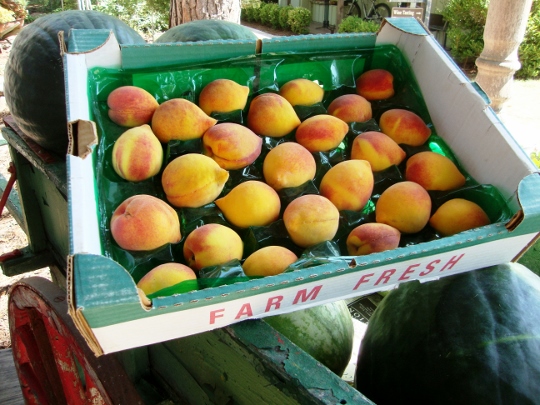
Today Mark still owns about 1,200 peach trees growing in tidy rows behind Das Peach Haus. But in recent years, he has leased these to Russ Studebaker, whose sons pick the peaches all summer and deliver them in trays to the store. The process never lets Mark stray far from memories of his father, a lawyer and bookkeeper who came from Germany in 1914 and settled in Fredericksburg in 1917. The man always fancied himself a farmer and first tied the family’s fortune to this land, growing not only peaches but apples, plums and wine grapes. At one point early on, Mark’s father even mimeographed a letter suggesting peaches as an excellent crop to local farmers, surely one of the forces behind the Gillespie County industry now stretching between Fredericksburg and Stonewall.

Though some peach trees were planted in Texas by the original Spanish explorers (and by the Franciscan padres who also gave the Lone Star State the beginnings of its wine industry), the official history of the Texas peach began in the mid-1800s. Before that, there was only a tree here and a tree there, planted as seed carried from Tennessee or Mississippi by settlers hoping for a little variety in their diet of pork, venison and corn. These proto-peaches tended to be small, a trait still favored by some growers in East Texas for their appropriateness for canning. In local parlance, these are unsurpassed “pickling peaches.” Yet, back in the mid-1800s, the reviews were not so kind. “The peach was frequently seen,” wrote an Illinois lawyer named John James, “but it was a poor thing.”
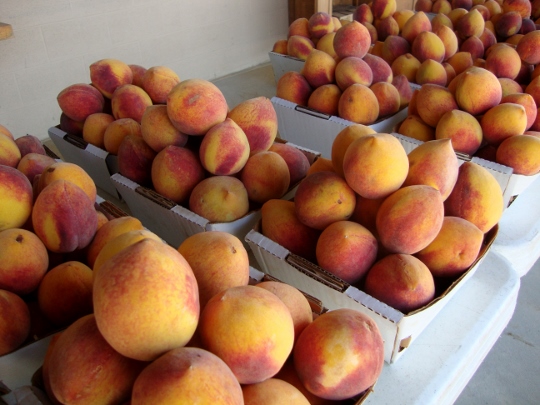
peaches tx 1 (540x405)

In 1851 a man named Gilbert Onderdonk, who described himself as an invalid, moved from New York to south Texas for health reasons. In some ways, Onderdonk became the first of today’s tens of thousands of “winter Texans,” who annually appreciate the benefits of escaping the cold. Still, in lieu of reliance on an RV, a lounge chair and a fishing rod, Onderdonk quickly came to rely on agriculture.

The warmth and fresh air of the region must have agreed with him (though he credited the Mexican lemongrass tea he downed at regular intervals), for by 1870 Onderdonk had built a national reputation for his nursery growing Texas and Mexican plants. Among these he counted several varieties of peach, a type of fruit to which he devoted considerable research. There, ten miles west of tiny Victoria, lived one of the nation’s true peach experts.

As president of the Texas State Horticultural Society, Onderdonk carried the Texas peach gospel to the larger world in 1904, with an assist from the landmark Louisiana Purchase Exposition in St. Louis. This event (which also popularized such food-world staples as the hamburger, hot dog, peanut butter, iced tea, cotton candy and the waffle-style ice cream cone) let Texas show millions of fairgoers all that its agriculture had to offer. When the first shipment of perfect peaches from Smith Country arrived in St. Louis in mid-May, Onderdonk was inspired to record: “No shipment of fruit at the Horticultural Palace created such a sensation as these Elbertas. So early, so perfect, so luscious were they that the admiring fruit growers were amazed. Such a thing as an Elberta peach at that early date was not dreamed of.”

Equally amazing to those who cared about such things, the peaches from Texas kept arriving at the agricultural exhibit well into November, thus foreshadowing a modern peach season that begins in the hot, humid Rio Grande Valley and doesn’t end till all the peaches are picked as far north as the Red River. Clearly Texas was displaying the longest peach season in all of America, with Onderdonk and his fellow peach growers picking up the fair’s horticultural grand prize.

peaches tx 7 (540x405)

By 1910, inspired by their success in St. Louis, Texas peach orchards had an estimated ten million trees. Yet, then as now, nature had a vote in the process and cast it with a vengeance. Between late freezes and hail, insects and disease, inexperienced growers looking for a quick profit learned the hard way that Texas peaches were nobody’s sure thing. Trees perished, as did the growers who owned them, even before the Depression put extra strain on every sector of the national economy. And all the time Texas peaches were suffering, California peaches were enjoying their more stable, more comfortable climate.

Intriguingly, in recent years, even as Texas peaches have become more and more accessible at roadside stands and farmers’ markets in the state’s metropolitan areas, more and more residents of those areas are opting to go out to the orchards themselves. Consumer favorites include Cooper Farms in Fairfield and Ham Orchards in Terrell. Pick-your-own places have also become popular, despite Mark Wieser’s caveat: “Never squeeze peaches. It hurts their feelings.”

Orchards in the Hill Country service Austin and San Antonio, with those in Montgomery and Brazoria counties tending to Houstonians. Parker County finds avid fans in Fort Worth, and Smith delights Dallas residents with one of the largest peach crops in the state. As with several other crops, only El Paso has to look beyond Texas for its peaches, finding a better and definitely closer supply just across the line in New Mexico.

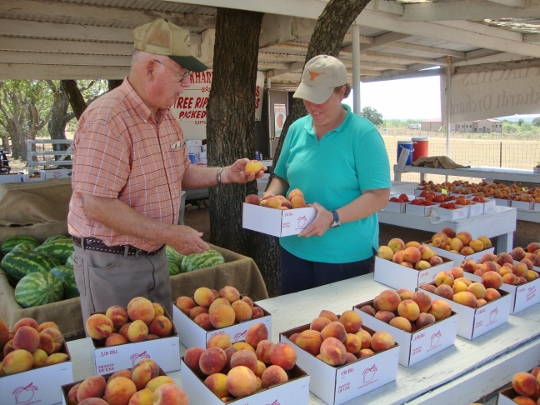
Back in Gillespie County though, the long, hot, dry summer burns on—making, as locals will tell you, the peaches even sweeter. And proximity being the mother of non-retirement, Donald Eckhardt turns up at the roadside stand to see how the kids are doing. On this day, the “kids” include his daughter Diane plus Beau Cox, who’s married to his other daughter, Debbie, who went to college for finance and has a day job. Alerted that a visitor might happen by to talk family history, Donald has filled four pages with his tightly knit scrawl.
peaches tx 4 (540x405)

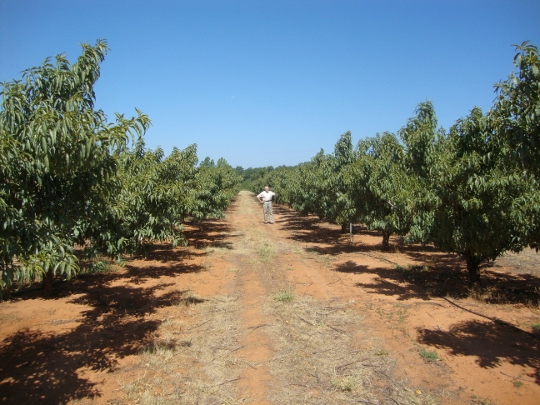
“My parents started farming and ranching around here in the early ’30s, with the focus on peaches by 1936,” he tells me, not really looking at his notes. “They had six acres and planted about 300 peach trees. There was drought sometimes, but most of the trouble was late spring frost, and that happened several times in 75 years. But all in all, we’ve been blessed with real good crops.”

Donald’s parents retired in the 1960s, letting him and his wife take over the orchards—building up to about 100 acres, 90 percent planted with peaches, plus a small number of plum trees. The varieties have evolved, too, he says, with virtually no peaches his parents grew still in production. Favorites now include Dixieland and Loring, both of which he says are “superior in quality and flavor.” Once his daughters took over in 2002, Donald watched the total peach acreage shrink to a more manageable 40 or 50, virtually all of the fruit reaching a hungry public via this retail stand.

While her father is speaking, Diane stands beside him, nodding from time to time, reminding him of this or that, and letting Beau handle the customers who pull onto the gravel off Highway 87 heading south toward Comfort. Finally, listening to the Eckhardt generational saga, she realizes it’s her chapter. “My sister and I went off and got college degrees in something else,” Diane says, hers in biology and nursing, “but you miss what you did when you were a kid with your family.” She thinks a moment, glancing down at her dad. “It always draws you back.”
peaches tx 5 (540x405)

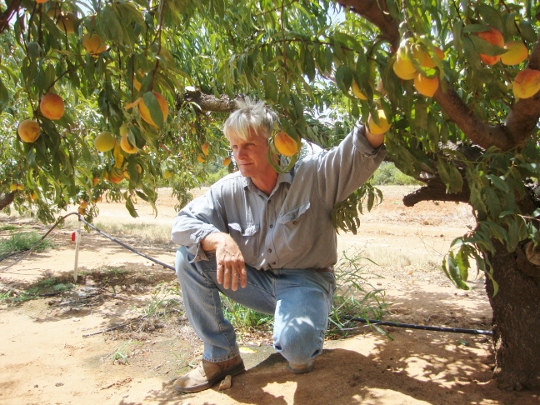
Russ Studebaker’s eight generations of farming history drew him to the peach orchards of Gillespie County—but only later in life. He grew up among the citrus groves of the Rio Grande Valley, but sensing little opportunity there, he joined the Merchant Marine for 20 years. Over those long decades of work on tankers and tugs, Russ started buying land between Fredericksburg and Stonewall as an investment, “because it was cheap,” he fills in. While he wasn’t sure when, or even if, his family would farm it, he no doubt took direction from the fact that generations of Studebakers had been farmers in America since the 1730s. They started in Pennsylvania, Ohio and Indiana. Russ says his grandfather “meandered” down to Texas during the Great Depression via the Dust Bowl in Kansas and Missouri.

Today, Studebaker Farm grows a wide variety of crops, including about 3,000 peach trees, whose 34 varieties keep the season going from May well into September. Spirited about progress, at any given moment Russ can show you some new technique or piece of equipment he’s trying out for the state. And as a one-man agricultural Answer Man, he can tell you exactly what he hopes it will do for his crops and his family’s future. Despite the 100-degree temperatures, he has even been building a permanent structure just behind the tents on Highway 290 where Lori and Annette sell fruit. When the building is ready next season, he says, the sisters will be able to offer the peach ice cream they’ve been perfecting. My sample bowl at Russ’s house makes this a happy prospect indeed.

“It’s funny,” he reflects. “I went to sea to get away from all this farming. And then I used the money I made at sea to get me right back on a farm. It’s a good life for my family, though. I really believe my sons are better off, getting up and working every day. I see them developing responsibility, a sense of discipline. I’m not so sure they’d been doing that in any other life.”
peach shortcake (405x540)


DM Radio in the Big Bend

Delicious Mischief, the popular food and wine radio program airing weekly in Houston, Dallas and Austin, spins off a quirky West Texas sibling called A Taste of Delicious Mischief Fridays at 8:20 a.m. on 1240 AM KVLF. Starting this Friday, Taste will be heard in Alpine, Marfa and Fort Davis spread out over Brewster, Presidio and Jeff Davis counties.

Hosted for the past 23 years by John DeMers, veteran journalist and author of 50 published books about cuisine, travel, history and culture, the program is built around interviews with chefs, sommeliers, winemakers, distillers and craft brewers. A Taste of Delicious Mischief is presented by Alpine’s historic Holland Hotel and its new Century Bar & Grill, along with founding Texas sponsor Spec’s Wines, Spirits & Finer Foods.

“Historically, this region was called the Trans-Pecos because it was on the far side of the river from, well, just about everything,” offers DeMers. “Now a remarkable number of wonderful chefs and restaurants are calling the Big Bend region home. As a parttime resident for several years, I look forward to telling stories about great food and wine - to the people I’m shopping next to at Thriftway or McCoy’s.”

A Taste of Delicious Mischief plans to expand to other towns in area, such as Fort Stockton, Van Horn and Pecos, as far north as Midland and the rest of the oil-rich Permian Basin – towns that serve as important feeder markets for both Big Bend National Park and the Holland Hotel. As such, Taste will serve as the “West Texas Edition” of the Delicious Mischief heard in the larger Texas cities.

“We’re pretty passionate about food and drink around here,” says hotel general manager Carla McFarland. “We couldn’t pass up the chance to join forces with a radio program and a radio guy who’s every bit as passionate about them as we are.”
DeMers launched Delicious Mischief as a Monday-Friday lunchtime half-hour 23 years ago in his food-crazed hometown of New Orleans. It quickly evolved into a weekend hour and followed DeMers to Texas a dozen years ago when he was named food editor of the Houston Chronicle, a position he’d earlier held worldwide for United Press International (UPI). Writing and broadcasting assignments have taken him to 136 foreign countries over the decades.

The current one-hour Delicious Mischief is heard each Saturday at 11 a.m. in Austin on KJCE 1370 AM, at 2 p.m. in Houston on KNTH 1070 AM and at 7 p.m. in Dallas on KLIF 570 AM.

As an author, DeMers has published nonfiction ranging from Follow the Smoke: 14,783 Miles of Great Texas Barbecue to Lone Star Chefs , Fischer & Wieser Fredericksburg Flavors and the most recent Reata cookbook. His fiction includes the Chef Brett mystery series (Marfa Shadows, Marfa Rocks and Marfa Blues), and the Danny Morales crime novel Terlingua Heat. DeMers is currently writing a cookbook with the legendary Cordua restaurant family of Houston and a book-length history of M.L. Leddy boots and saddles of San Angelo and Fort Worth.

KVLF, broadcasting to listeners in Alpine, Marfa and Fort Davis with its sister FM country-music station KALP from baseball’s beloved Kokernot Field, calls itself The Voice of the Last Frontier. “I love that,” says DeMers. “For me, the shoe – on in this case, the boot – definitely fits.”
Mexican Food in the Capital

For any Texan to go looking for Mexican food in or around the nation’s capital might seem something of a fool’s errand, or at least a recipe for likely disappointment. Certainly a handful of years ago, such a quest would have been a waste of time. But thanks to a new place in Arlington, Va., called Fuego Cocina y Tequileria, it’s easy to find (as Fuego’s subtitle implies) the two most important things to a displaced Texan’s happiness.

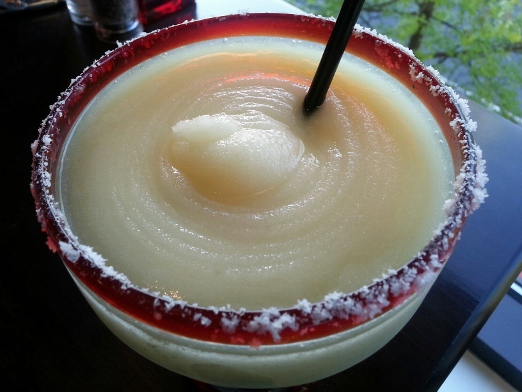
Yes, there are a 125-plus different tequilas in the bar area downstairs - and least according to chef de cuisine Alfredo Solis of Mexico City, who admits to liking his country’s native spirit just fine. As a result of the supply, there is a demand. And that means plenty of flights of various, often-high-end tequilas for tasting, and also of course the now-wildly popular margarita. You can, of course, enjoy your margaritas at Fuego on the rocks or, as pictured here from my dinner, frozen.

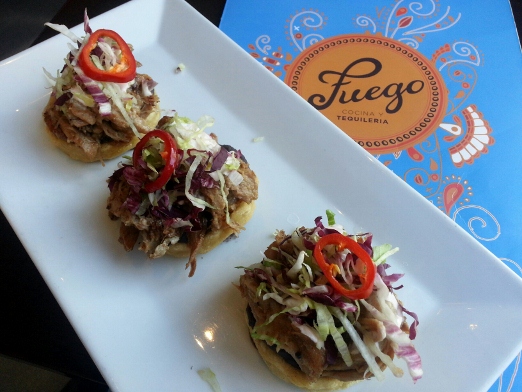
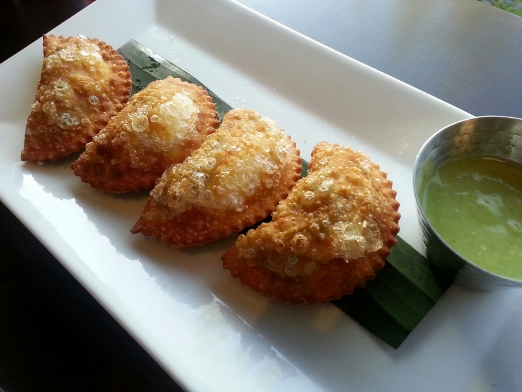
D.C. and the suburbs of northern Virginia have many adherents to variations of vegeterianism, and quite a few of them gather around these vegetable empanadas. No, they’re not the least bit vegan (though they can presumably be made that way), considering the goat cheese that finds itself splayed across the vegetables. These, however, are plenty delicious, representing bigtime gifts of the Americas to the world: roasted squash, corn, huitlacoche, epazote and avocado. If that’s a bit too hardcore vegetarian, you’re sure to love the sopes de carnitas pictured at the very top. These are slow-roasted pork on small shells formed of masa and accented with black beans and sour orange habanero crema.

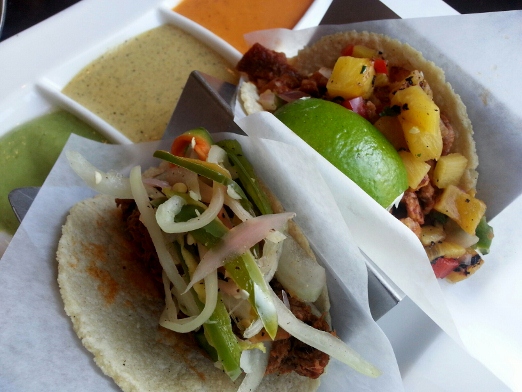
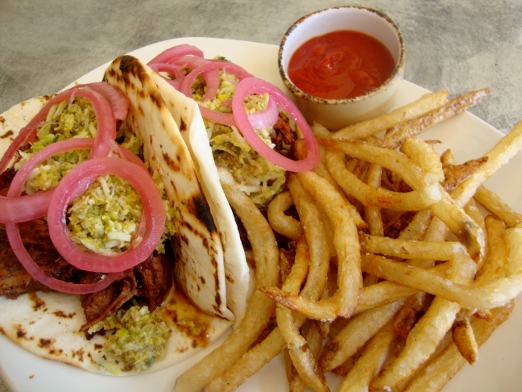
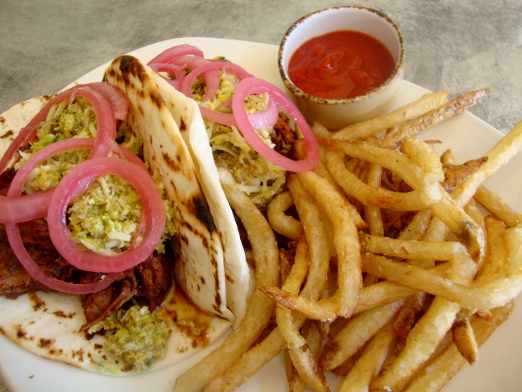
It would be tough carrying off any form of food described as Mexican without tacos, so the chef and rest of the staff at Fuego make no such attempt. In fact, the menu features nine different variations on the taco, some representing the traditions of specific regions in Mexico and some apparently flights of chef fantasy. Here are my two favorites from my tasting: birria (Jalisco-style roasted goat) and al pastor (spit-roasted marinated pork with pineapple serrano salsa).

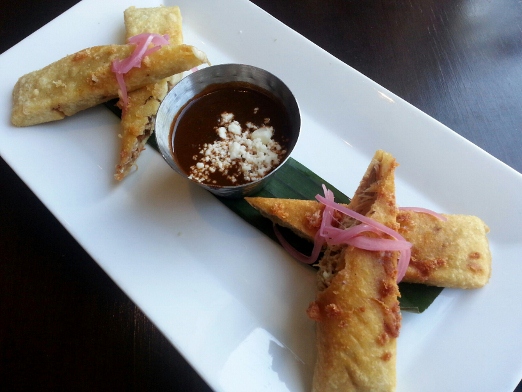
If your table is looking for one more intriguing way to kick off dinner at Fuego, which means “fire” in reference to its spices, you can do lots worse than these flautas (flutes) filled with shredded duck confit. Confit, naturally, is as French a technique as the name implies, but the flavors find a nifty balance between familiar and exortic. There’s a whole Oaxacan thing going on, between the queso from there and the intense, sweetish mole negro.
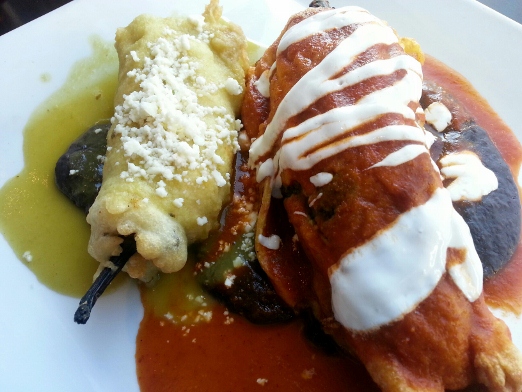
If your stomach insists on a main course, even after so many terrific appetizers, Fuego offers nine especialidades de la casa, a level of Spanish almost anyone should be able to understand, plus a nightly special or two - which I suppose makes these special especialidades. As usual, it depends on what you like. Still, I was intrigued with the chiles rellenos divorciados. Having enjoyed “divorced eggs” as part of Mexican breakfast in Texas, I couldn’t resist the notion one chile stuffed with cheese and the other with ground beef picadillo, plus salsas verde and roja.

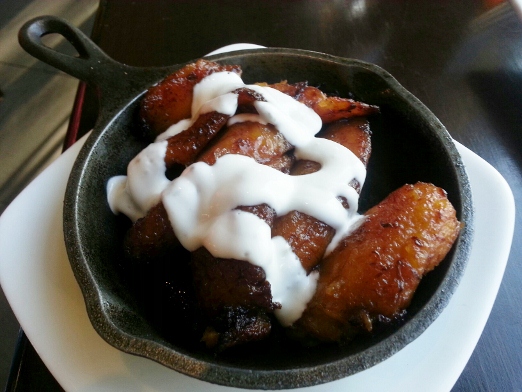
One departure from Tex-Mex in Texas was the absence of rice and beans with every entree that goes out, and I have to admit that’s always a disappointment to me. Instead, Fuego offers your choice of one side dish from eight, including both arroz a la mexicana and frijoles refritos or frijoles charros. Since I was already far out of my rice-bean comfort zones, I opted for these platanos machos - tequila-glazed ripe plantains with Latin crema.

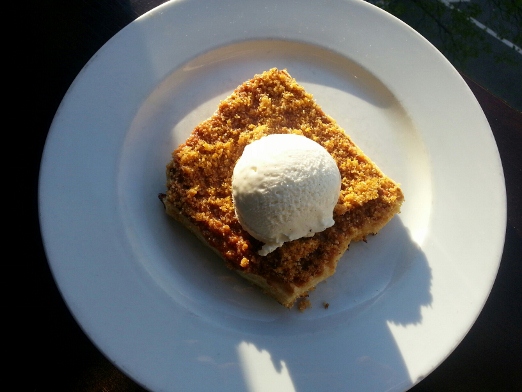
God and tequila willing, you finally make it past savory dish after savory dish from chef Alfredo’s kitchen and get a chance to think about dessert. After sampling so many things, I can’t say I had “room” for dessert - but then again, when is dessert ever about having room? Part of me wanted to try their rice pudding - billed by tradition as arroz con leche, or rice with milk. But I let myself be swayed toward their most popular selection, a kind of Mexican French toast (there’s some history for that, after all). And since the whole thing gets covered with the lush caramel called dulce de leche, I’ll invent any history I have to to justify another helping the next time I visit Fuego in Arlington.


1st Big Bend Food Festival

Mussolini may have been famous for making the Italian trains run on time, but he never lived long enough to work with or for Amtrak. And despite a truly weird invasion of Ethiopia, he never tried anything quite as outlandish as staging a food festival in what has to be the single most remote area of Texas. That job was left to a young fellow named Stewart Ramser, who already had one Viva Big Bend Music Festival under his belt before attempting to enjoy the same success with food.

There was no shortage of surprises during the festival this past weekend, yet one of them probably wasn’t that the Amtrak train organized from Houston to Alpine arrived several hours behind schedule - courtesy of a freight train that happened to be blocking the track west of San Antonio. Still, by the time the Foodie Train (a rail car commandeered by Abbey Branch, originally of Alpine but now of The Woodlands) pulled into the depot, people were happy to set foot on terra firma for all kinds of excellent reasons.

The Foodie Train had one major draw beyond a non-driving trip to and from the Viva Big Bend Food Festival: Houston celeb-chef Monica Pope of Sparrow Bar + Cook Shop, who served food on the overnight train heading west, taught several hands-on cooking class once arrived, and even staged a pop-up dinner in an iconic Alpine hardware store. With a band keeping the depot lively, Pope here receives the key to the city from the mayor of Alpine - a longtime chemistry professor and then movie-theater operator known around town as “Dr. Rangra.”

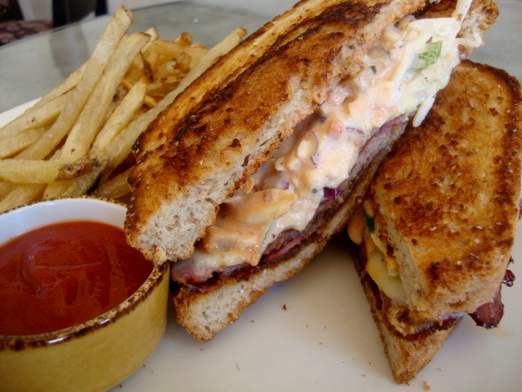
While there were events attached to the festival - and live music every time you turned around - most of the eating took the form of restaurant opportunities in the four towns of Alpine, Marfa, Fort Davis and Marathon. It was possible, only months after Century Grill opened for dinner at Alpine’s historic Holland Hotel, to also enjoy the new lunch. Pictured above is the Kinky Friedman Reuben sandwich, a kind of “Texas Jewish” thing featuring smoked brisket where the deli corned beef would typically be.

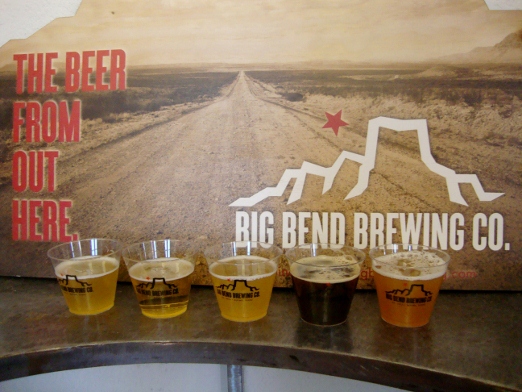
There was also a presence of one of America’s newest craft beer operations, Big Bend Brewing Co. in Alpine. Though the business is barely a few months old, its head brewer started out making beer at home (as have so many in the craft beer movement) and then spent more than two decades making it professionally in Austin. Big Bend beers are now available only by the keg in bars but soon will be making the jump to cans, with an eye on Texas-wide distribution.

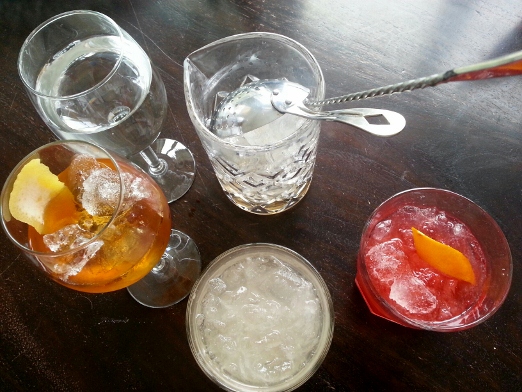
Althought the event title mentions only food, there were plenty of things to drink - mostly in conjunction with live music in any venue imaginable and a few that maybe weren’t. Tito’s Handmade Vodka of Austin was on hand, being deftly stirred into cocktails by mixology consultant David Alan, whose new book Tipsy Texan is due out in June. Who knew just how “Texan” vodka could be?

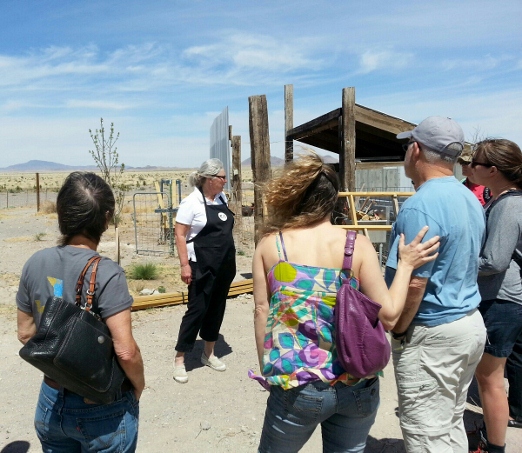
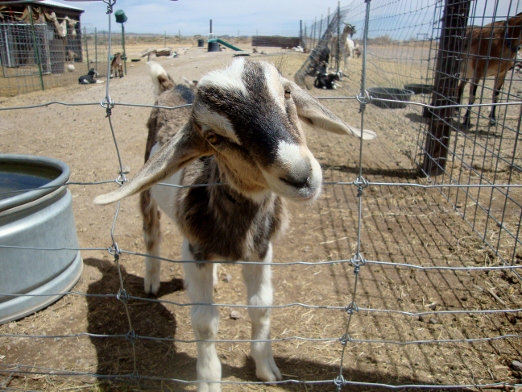
For many, a highlight of the entire festival was a trip by van out to the Marfa Maid goat farm and dairy, where Malinda Beeman and Allan McLane have joined forces to produce several variations of first-class goat cheese. The Marfa Maid line is sold at several local retailers, plus by Malinda herself at each Saturday’s Farm Stand Marfa.

It isn’t often in life that you get to pet the goats, see the milking operation and finally hear all about how that milk becomes cheese. Talk about getting back to nature - and of course, very Marfa, through and through.

Every bit as quirky, come to think of it, was David Beebe’s fanciful Airstream Land built around his own taco food trailer called Boyz 2 Men. As you can see amid the Houston native’s growing collection of vintage Airstreams, this stark corner facing Highway 90 can also proclaim itself the Smallest Drive-In Movie in Texas. There were several events held here during the festival, including one no-doubt beer-besotted movie night.

Just down the street from the Holland and its Century Grill, there’s a class-act bar that also serves excellent food called the Saddle Club. Western hipster from head to toe, the chefs behind the place are so committed to drinking that they serve only foods that make you drink. And that isn’t necessarily a bad thing.

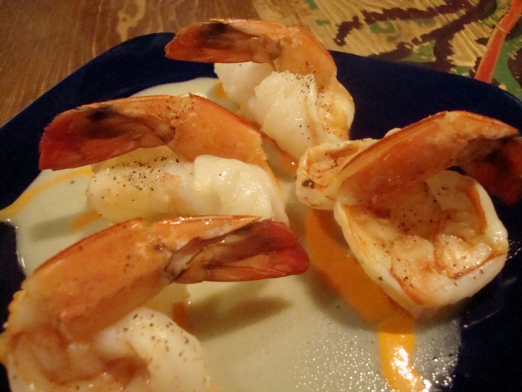
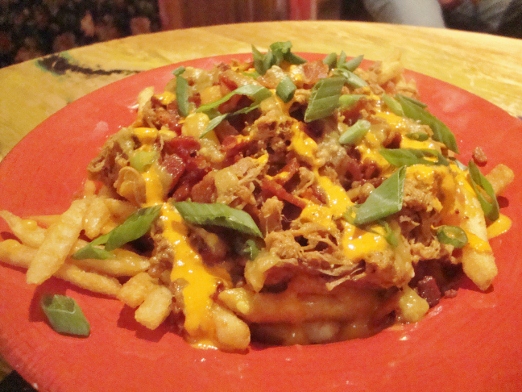
Consider, for instance, the Saddle Club’s ”Stephen’s Scrimp” with roasted garlic beurre blanc and roasted red pepper aioli, or these beer-battered “Epic Fries” topped with smoked brisket, queso, bacon and a squirt-bottle swirl of sauces tending toward the hot. And as though just in time to celebrate the first Viva Big Bend Food Festival, the place finally got its own neon sign. Like so many things about the weekend, it was art that lit up the night.


Houston Weekend on Wheels

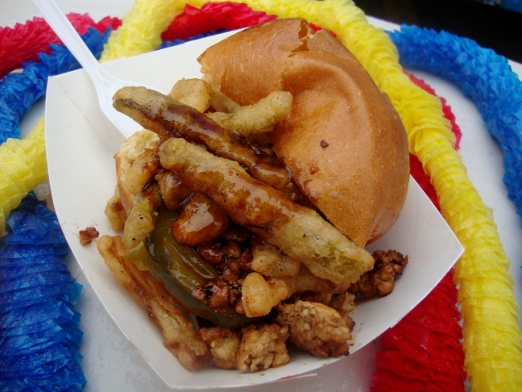
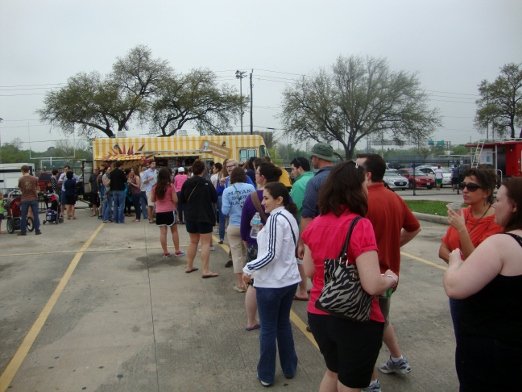
The skies were gray and the drizzles recurring today at the Haute Wheels Houston Food Truck Festival. Yet neither of those things could prevent a Bastille-style storming of the 35 or so participants and their oh-so-edible wares. Based on the line to buy tickets, the line to trade online paperwork for tickets, the line to get into the gates and the line outside most of the trucks, Haute Wheels is clearly a big success. As far as I’m concerned, the best newcomer this year is Big Daddy Z’s, which served this Jamaican-flavored jerk pork sandwich with fried jalapeno and onion strings. And you get lei-ed while you’re at it!

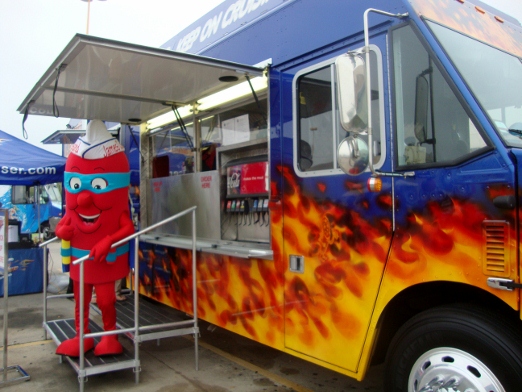
Haute Wheels, which picks up again tomorrow at the HCC campus on the 610 Loop, is also a lot of people’s introductuion to the new ConeyCruiser, a creation of James Coney Island that’s described as the largest food truck in Texas. According to JCI president Darrin Straughan, on hand for the festival, the Coney is no effort to mimic the chef-driven trucks so popular these days but to deliver the branded coney dogs to diners in less familiar settings.

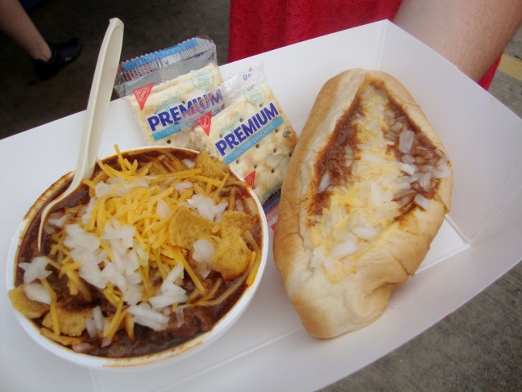
“Our truck,” says Straughan, ”is very popular as a ‘shabby chic venue’ for private parties and company events, and its kitchen is equipped to produce all types of menu items.” For Haute Wheels, James Coney opted out of venturing too far from the tried-and-true, showcasing not only the original coney with chili, cheese and onion but its variation on traditional Texas Frito pie. This is a brand-new truck, you might say, with 90 years of experience.

As in years past, part of the challenge of putting on a food truck festival is getting the trucks themselves to deliver what the customers demand. After all, as a customer, once you’ve bought a ticket and made your way inside, your business is with the individual trucks, some of whom accept credit cards and some of whom demand cash. More tellingly, some have worked through menu issues to the point they can cook and serve quickly, and others have not. Finally, some trucks simply have a bigger following than others.

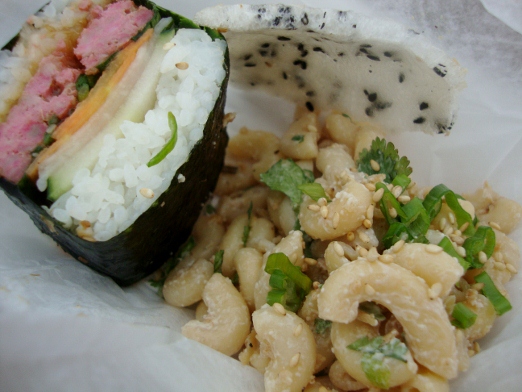
So… when is SPAM more like sushi? Answer: when it comes from the Vietnamese fusion food truck MiSuBi. In this particular sandwich, accompanied by Asian-tasting elbow macaroni coated with sesame seeds, the all-American meat product is rolled up in seaweed with plenty of crunchy vegetables. Bold Asian flavors also play a big role at Coreanos (Mexican with Korean) and a handful of other festival participants.

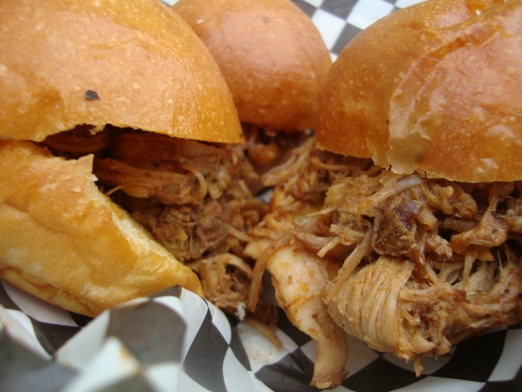
Though it’s not always obvious, one of the more interesting aspects of the food truck movement is the varying degrees of professionalism behind the food. Some successful trucks are just people who always wanted to do something like this, maybe even parttime. Others, like Fraiche, are the work of professionals. These pulled pork sliders, for instance, are the creation of a trained chef and a trained pastry chef.

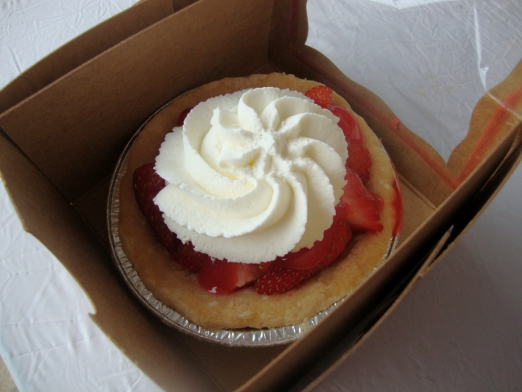
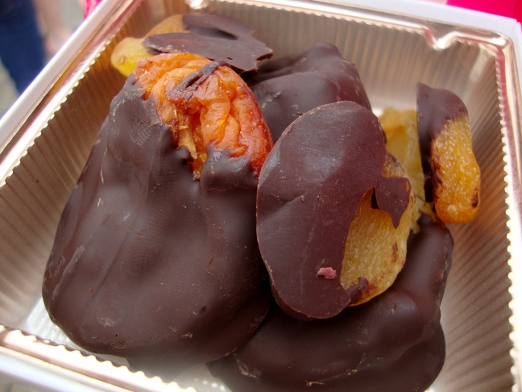
Dessert seemed a happy choice at Haute Wheels today: first, because it was easy to get sweet at the festival when the rest of the multitudes were gorging on savory. And second, because desserts have to be made in advance. Who, after all, wants a Bananas Foster truck, if each order has to be flambeed before your eyes? Above we have a light and wonderful strawberry pie from Porch Swing Desserts, below a box of Belgian-inspired confections of dried fruit and chocolate from Chocolat d’Arte.

Munching Along the Midway

Year after year, since the competition kicked off five years ago, I’ve loved helping judge the Gold Buckle Foodie Awards at the Houston Livestock Show and Rodeo. After all, I have the other 364 days to go on a diet. How else can I hope to taste nearly all the foods served by vendors on the midway and in the mammoth exhibition hall? And how else can I hope to locate instant classics like these Red Velvet Frosty Bites by Custom Confections, the iconic cake baked in a cup, filled with cold ice cream and topped with what amounts to cheesecake icing. These Bites, by the way, convinced us judges to give them the top award in the category titled Most Creative Food.

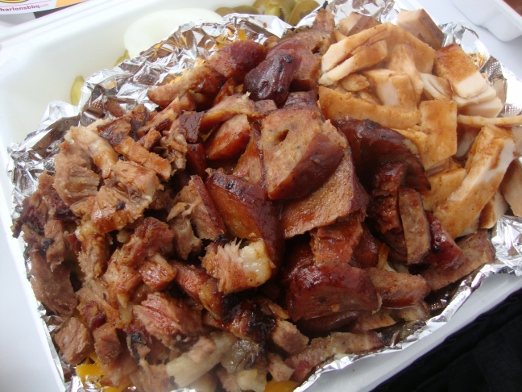
At a rodeo, or a carnival, or anything else serving what’s come to be lionized as “fair food,” some dishes aren’t so much Creative as they are just Big. That certainly applies to this Super Baked Potato from Harlon’s BBQ. I believe the potato itself is large, even though it’s pretty hard to locate it under this onslaught of smoked beef brisket, sausage and turkey. I, for one, love that each meat has a kind of “zone” to itself. Very orderly, that way. This baked potato, which I rated even higher personally, took home third place in the Best Value Food category, behind the Ribs and Chicken Platter from Saltgrass Steakhouse in first and the Pizza on a Stick from Swain’s in second.

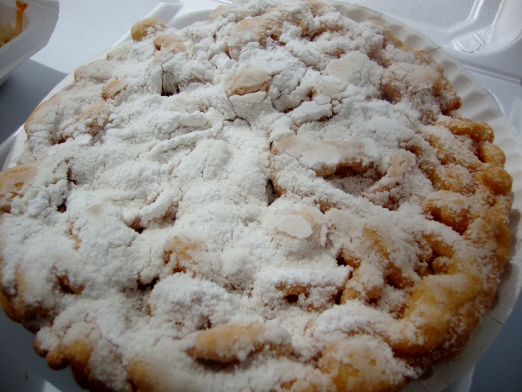
I found myself wondering yesterday, as dish after dish appeared before me, when in history “more” became indisputably better - when a corndog had to have chili and cheese ladled over the top or, even worse, when a cheeseburger had to be bunned, battered and deep-fried. When confronted with a simple, straightforward funnel cake topped with powdered sugar, I wondered if some things weren’t created by God to be exactly what they are. Then again, we judges did give a second place in Most Creative Food to a Donut Double Bacon Cheeseburger, with a glazed donut where the bun ought to be.

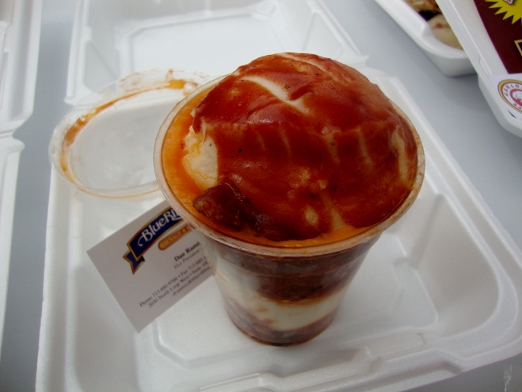
I don’t think I’ve ever seen the phrase trompe l’oeil used on a sign at the rodeo, and since “potato” comes out “potatoe” often as not, I’m not so sure I want to. But one of my favorites has got to be this fool-your-eye spin on an ice cream sundae. The ice cream is mashed potato/e, while the topping is BBQ beef, and the chocolate sauce is, naturally, replaced here by barbecue. As required (by me) for this sort of thing, the creation from Frankie B. Mandola at Bum’s Blue Ribbon Grill is not only clever but delicious.

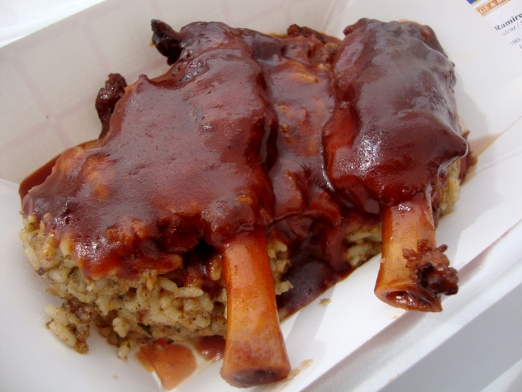
Frankie B. doesn’t need to cry for me or for Argentina, for not winning an award for the sundae - which did cause quite a stir when it first appeared a year or two ago. This year Bum’s Blue Ribbon Grill picked up a second in Best New Flavor for these Grilled Pork Ribees with Dirty Rice. I loved this one, especially the exemplary Dirty Rice. It came in right behind the Cookie Dough Parfait from Aunt Edmoe’s and right ahead of the Do-E-Oreo from a vendor called Fried What! Spelling and punctuation are theirs, not mine…

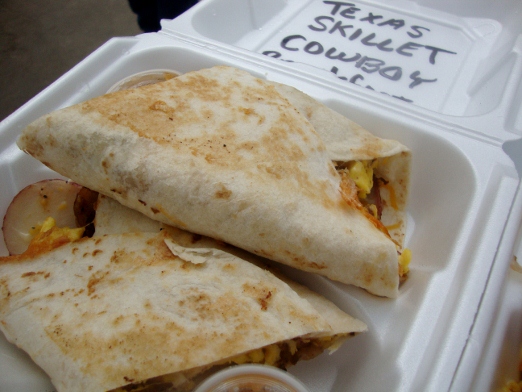
For the Rodeo’s nearly 30,000 volunteers, days can get started mighty early. And that means that, when it comes to food, they are the midway’s ”first responders.” One of the breakfast dishes they are - not surprisingly - responding to best this year is this Cowboy Breakfast from Texas Skillet. It was the first item to arrive at our judging table, and (since judges start off hungry in hopes of survival) we were very happy to see it. We gave it second place in the Best Breakfast Food category, topped by the Big Stone Breakfast Sandwich from Stubby’s Cinnamon Rolls and followed by the Breakfast Taco from Burton Sausage Co.

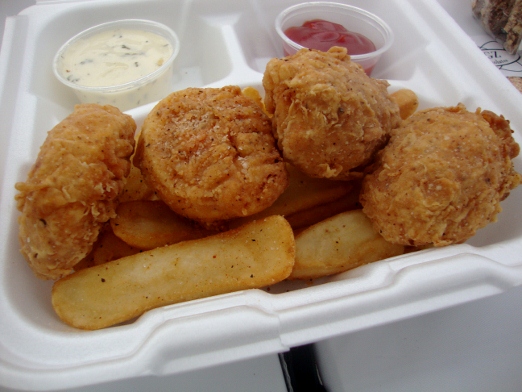
These deep-fried (or were they chicken-fried, like half the other things at Rodeo?) deviled eggs were part breakfast and part appetizer. It was, generally, considered a cool idea - not least because most of us are familiar with the sausage-laden “Scotch eggs” so popular in Great Britain. Maybe next year we’ll see some Deviled Scotch Eggs. Nobody ever made us judges hate them by adding sausage to anything. And while we’re at it, Fried Food honors went to the Original Corny Dog from new vendor Fletcher’s, followed by the Fried Brownie Ball with Ice Cream from Custom Confections (yes, they of those red velvet cupcakes) and the Fried Oreos from Still’s Funnel Cakes.

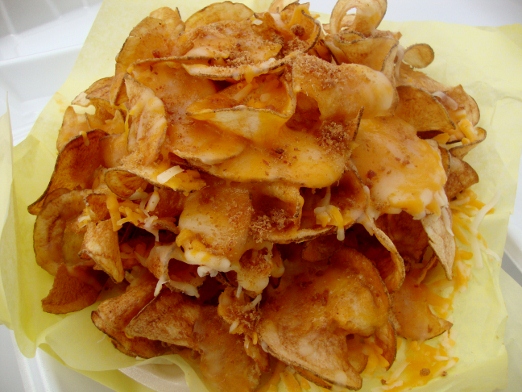
How on earth did I get off the Rodeo grounds without taking a photo of anything on a stick? We did judge a sausage on a stick that was about two feet long, with all the resultant obscene remarks. But while you’re eating these gooey-delicious loaded potato chips, I can tell you that the Food on a Stick category ended up with Shrimp Diablo from Berryhill Baja Grill in the top spot, followed by Pizza on a Stick from Swain’s and The Big Rib from RCS Carnival.

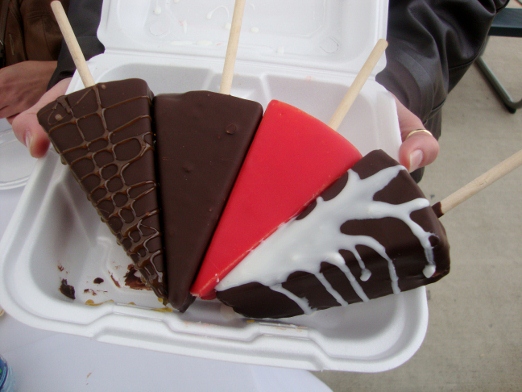
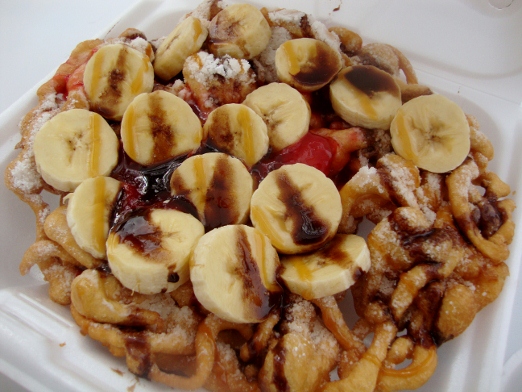
And while none of my personal favorites took home awards in it, that leaves only the official Best Dessert category. Winners were the surprisingly simple Cinnamon Glazed Pecans from Go Nuts and More in first, Apple Slices with Caramel from Carmelot (I DO like the name!) in second, and traditional Apple Pie & Blue Bell Homemade Vanilla in third. All good, obviously. But what I really liked best - other than those cupcakes - were the frozen cheesecakes on a stick pictured above and the funnel cake topped with bananas just below. You see, bananas! Really now, who ever said you couldn’t eat healthy at the Houston Rodeo?


The Master of Avery Island

When former Tabasco president Paul McIlhenny is laid to rest this coming Wednesday, a lot of people will remember a lot of things about him - his immense love of food and drink, his support of chefs from anywhere but especially from Louisiana, his concern for his state’s endangered wetlands and, of course, his promotion of that famous pepper sauce until the iconic product was sold in 165 countries.

I’ll mostly remember him for the ties.

Sure, one of the primary “takes” of Louisiana food tourism is a visit to the McIlhnennys’ Avery Island near New Iberia, a peppery pilgrimage I made several times. Like the sweet garlic that rides the air currents when you drive through Gilroy, Calif., or the muscat wine that perfumes your every breath in the French town of Beaumes de Venise, the aroma of peppers, vinegar and salt always made me hungry whenever I visited the place Tabasco was made. But whenever I visited Paul himself, is his office highrise in New Orleans, he always took me to a drawer, pulled it open and said with a wide grin, “Take as many as you like.”

What that drawer contained, in abundance and in variety, was branded Tabasco neckties, some that screamed “walking advertisement” and others that were much more subtle. You have to understand: I did a weekly TV show in New Orleans for many years, talking about food naturally, and it got where the only ties I wore on the air were Tabasco ties. To me, it was a “food statement.” To Paul McIlhenny, it was the sort of thing he’d been doing since his birth (in Houston, no less) in 1944. He and I had a running gag about the Tabasco boxer shorts that filled the drawer next door. “I’d take some, Paul,” I said even after the joke was very old, “except nobody will ever see them on TV.”

Tabasco sauce, however - Paul would tirelessly correct me: it was “Tabasco brand pepper sauce”- and not ties, boxer shorts or aprons, remained the McIlhennys primary product from the day the company was founded on Avery Island in 1868. Edmund McIlhenny deserves the credit for that, though several of his successors deserve kudos for making the stuff a household word. During the world wars that formed the 20th century, and all the way through Korea and Vietnam, Tabasco followed American GIs into battle. It was either a taste of home or a taste they’d want at home for the rest of their lives. As Paul liked to put it, “We’re defending the world against bland food.”

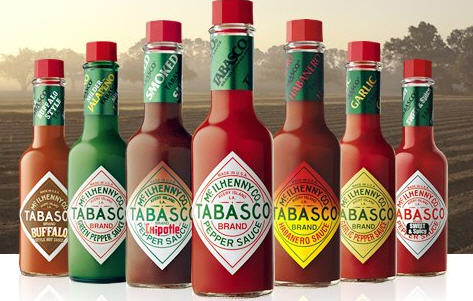
To that end, he would spend time regularly with all of us who wrote or broadcast about the world of eating or drinking. Sometimes it was to champion an aspiring Louisiana chef (who no doubt was using Tabasco in his signature creations) and sometimes just to take the culinary temperature. And then, there were the launches, following the American taste buds into variations on the family theme like jalapeno (which had the nerve to be green in that oh-so-recognizable bottle) and even smoke-kissed chipotle. Salesman that he was from birth till death, Paul understood that the more things people thought his pepper sauces were good on, the more of his sauces we’d want, use and buy.

At one such dinner - they were always held at nifty, expensive places like Ruth’s Chris Steakhouse - I may have given Paul an application he hadn’t thought of, or maybe he was just being nice. He was ending an extended homily about how great his classic red sauce is on the fried eggs that Americans were still supposed (in his mind) to eat for breakfast every morning. He was right, if you haven’t tried it. Tired of being one-upped, however, I informed him that my favorite combination was Tabasco’s green jalapeno sauce on corn on the cob, with butter or even without.

“Wow,” Paul uttered after a long pause, visibly running the flavors of juicy corn and the hot-salty-pleasantly-vegetal liquid through his mind’s gifted, globe-trotting taste buds. “Yeah,” he said slowly, as though the fate of the free world depended on it. “That would work.”


Happy Birthday to Sullivan’s

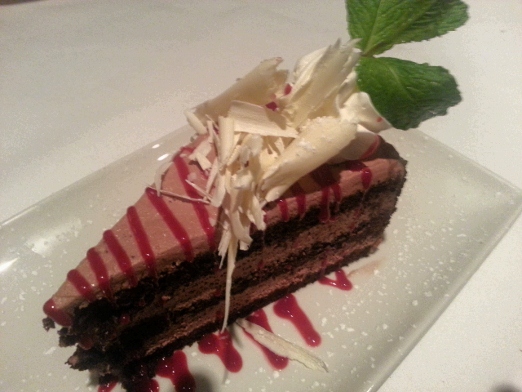
I actually do love birthdays, mine or anybody else’s, even though I often forget what date they fall on or exactly what I’m supposed to do about it. But when it comes to Sullivan’s Steakhouse, celebrating its 15th birthday in Houston, I know what to do: go there to eat and drink. Which is exactly what happened to me last night. And as you can see above, the folks at Sullivan’s were thoughtful enough to bake their own chocolate mousse birthday cake.

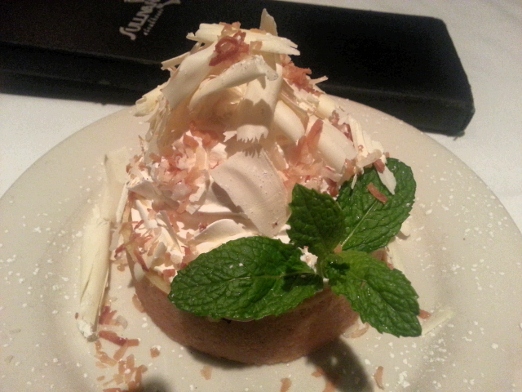
Then again, if you go to Sullivan’s between now and the end of the month, no one will force you to have birthday cake for dessert. Good days or bad, in fact, I’ve always been partial to this un-pie-shaped coconut cream pie. There is a smooth and, of course, creamy coconutty filling inside what’s more like a ring than a crust, plus shavings of what is or ought to be white chocolate. Sullivan’s also turns out a nifty version of key lime pie. As a guy who wishes he were in the Florida Keys approximately every 12 1/2 minutes, I had to have that too.

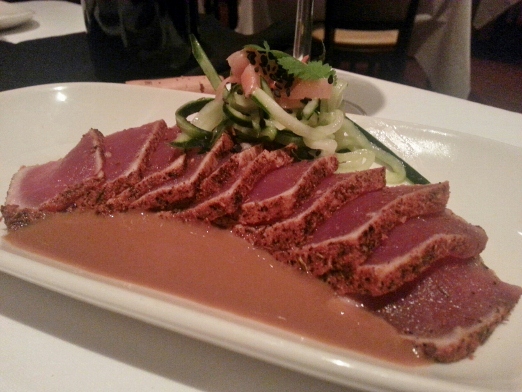
One of the joys of last night’s dinner was catching up with regional executive chef Aristotelis Trikilis, or Chef Teli for short. Though based in Houston, Teli is responsible to all the Sullivan’s on the West Coast, which means (as it puts it in his rumbling, rolling Greek accent) from Alaska to Tucson - and Houston, naturally, with executive chefs and sous chefs in each restaurant. Somewhere in all of his travels, Teli manages to create, perfect and approve wonderful dishes like this tuna tartare appetizer, crusted with Cajun seasoning and set atop pungent English mustard sauce.

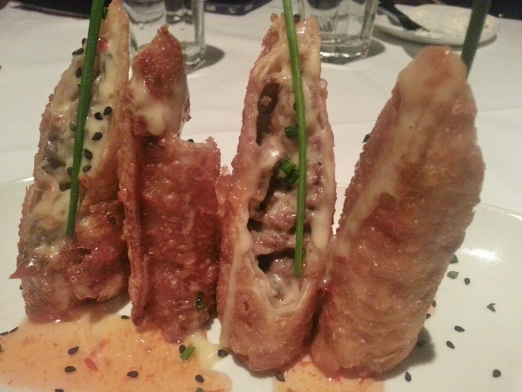
Chatting last night with still-new Houston GM Alex Truong, I realized that the Sullivan’s story keeps getting, in those words from Wonderland, curioser and curioser. Sullivan’s has traditionally been the less expensive, slightly more everyday and, in some ways, less frilly sibling of Del Frisco’s Double Eagle Steakhouse. Still, in the next month or so, these two concepts will be joined by a third that’s more casual and less expensive still: Del Frisco’s Grille, opening in the lively West Ave development. As such, Sullivan’s will become the corporation’s ”middle child,” and it should be fascinating to see how all those things shake out. And yes, the nature of things let’s Sullivan’s spin its own version of popular Del Frisco’s items, like these almost over-indulgent cheesesteak eggrolls with sweet-spicy chili sauce and honey mustard.

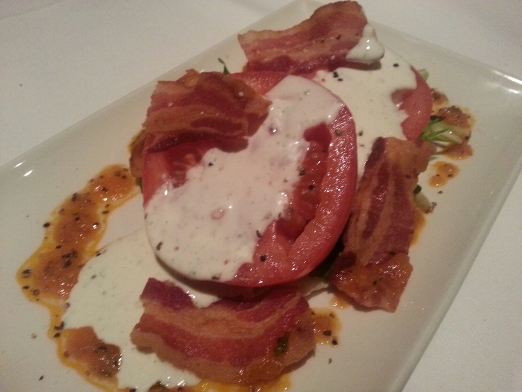
Salads at Sullivans are a case of something old and something new. Surely the classic within these walls is the iceberg wedge, preferably with bleu cheese dressing and crumbled bleu cheese on top of that. That’s still amazing, for me a blast from the past since such salads were part of my earliest memories of oldtime, family-friendly steakhouses. But I love the newer BLT salad even more, complete with both roasted tomato and garlic ranch dressings. And did I mention applewood-smoked bacon?

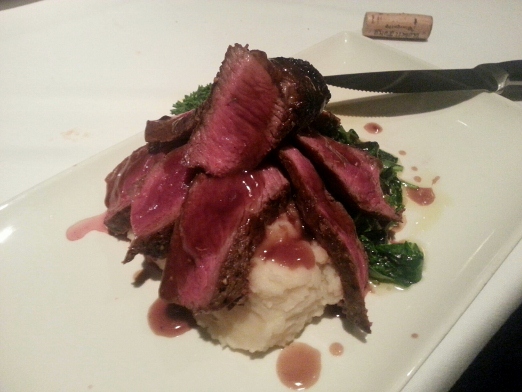
A similar thing happens with the steaks at Sullivan’s. You can get any traditional cut of beef, from filet mignon to New York or KC Strip to ribeye to porterhouse (the latter my favorite, solely because the late Ruth Fertel told me that’s what she liked best!). But Chef Teli concocted something a little special: slices of New York strip with what I believe he said was a porcini or other mushroom crust, displayed rather artfully atop horseradish mashed potatoes. Even this porterhouse lover couldn’t resist.

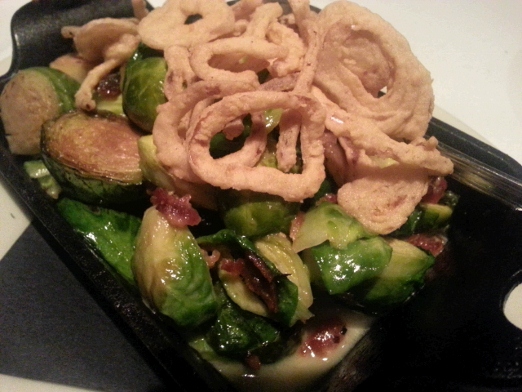
Sides are a pretty big deal at Sullivan’s, even though not quite as big a deal as they are at, say, Del Frisco’s. Above we have what I call Brussels sprouts 101, meaning the tiny cabbages cooked with no small amount of bacon. They are, in short, Brussels sprouts for peoplke who don’t like Brussels sprouts. As with white zinfandel and other “starter wines,” I guess we should be grateful for the introduction. And putting fried “shallot rings” on top doesn’t hurt either.

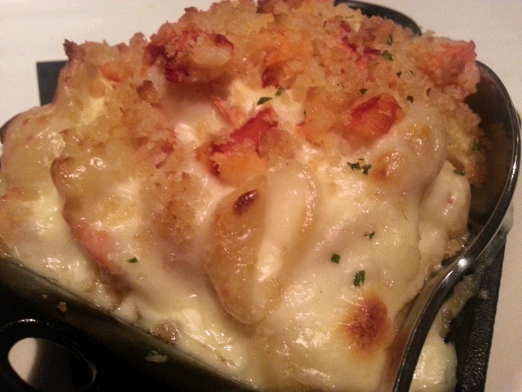
One of the things steakhouses love to do these days is find a classic home-cooked dish and upgrade it beyond what anybody would ever do at home. The goal is a sense of celebration, and affluence is primarily what such dishes celebrate. That fact that, on so many nights, the dining room at Sullivan’s is replete with Houston Texans, Rockets and Astros is, therefore, no accident. My feeling about such dishes not withstanding, it’s hard not to dig into Sullivan’s crusty-topped lobster mac and cheese. I’m just happy nobody assaulted it with truffle oil!

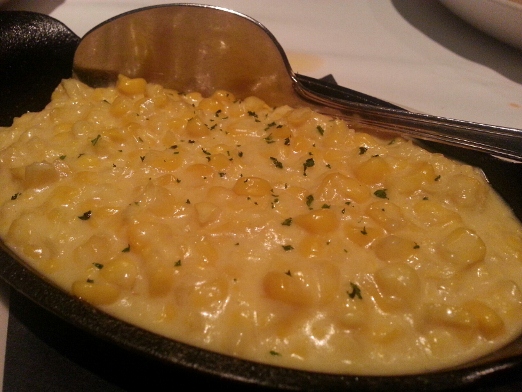
Every so often, however, affluence-celebrating restaurants like Sullivan’s - and higher-ups like Del Frisco’s but also lower-downs like Del Frisco’s Grille - figure out how to leave well enough alone. Thus one of my favorite dishes Chef Teli, GM Alex and charming server Jessica set before me was this creamed corn. No lobster, no truffle oil, no caviar or foie gras. Simply kernels of sweet corn in what I assume is plenty of cream and butter, the way it might be made on a farm with plenty of those things and no money changing hands at all. That’s a welcome reminder when we’re celebrating a birthday - be it Sullivan’s, somebody else’s, or even our own.


Sunday Supper at Liberty

In this life, nothing’s harder to displace than a memory. For me, “Sunday supper” has always been my late father (and my late mother too, since we’re conjuring) making pizza in the kitchen while we kids watched Walt Disney’s Wonderful World of Color - on our black-and-white TV. My father always started by sauteing Italian sausage, thinly sliced bell pepper and chopped mushrooms, throwing off an aroma that still makes quick work of the decades in between. From now on, however, Sunday supper just might be these “crazy” grilled oysters topped with ”bacon jam” at Houston’s Liberty Kitchen.

As long as we’re talking memory, I do believe Liberty Kitchen serves the best sliders I’ve ever tasted. And I speak with some authority, since I grew up eating at a variation on White Castle known in New Orleans as Royal Castle and had my first “real” job in college bopping between the burger grill and the French fryer at the super-busy McDonald’s across from the old Boston Garden. At Liberty, the ratio of meat to cheese to bun is, well, perfect, as are those lovely swatches of ketchup, mustard, pickle and diced onion. The fries hidden behind this happy trio - according to this expert - are amazing too.

Liberty Kitchen, which opened in the Heights some months ago, is the culinary vision of chef-owner Lance Fegen, with whom I recall many a long, rambling conversation about food, drink and service at the end of the night at downtown’s Zula a dozen years ago. Besides taking a couple years “off” to surf in Costa Rica, there have been a few itirations of Lance since then, including Glass Wall and BRC. In terms of both partnership and philosophy, the route from BRC to Liberty Kitchen is an unbroken line. There’s a big menu of things people love to eat. Take these fried onion rings, for instance. On second thought, get your own.

When I have these fried green tomatoes topped with crabmeat and sided with grilled shrimp in my mouth, I think Liberty’s Sunday supper is special. But really, this dish and 99% of the others are available all day every day - apparently another lesson Lance learned on the way to making people happy with food and drink. People are so happy with Liberty Kitchen, in fact, that plans are already in motion to open a second location on San Felipe near the St. Regis or the Target, depending on your tax bracket. They’re opening in the old Vivo space, which then became the Vida space, which then became the empty space. A lot of folks in that neighborhood can’t wait.

So yes, there is beef brisket on the menu at Liberty Kitchen - but it’s about as far from Texas BBQ as Transylvanian-born, Jewish-deli pastrami might be. The seasonings are completely different from our local “dry rub,” and it’s roasted instead of “low and slow” smoked. It’s a terrific rendition, though, the meat fork-tender under that great big glistening knife you don’t need, and even better when dunked into the mushroom gravy. You get to choose your side with the brisket and any other entree here. You can do lots worse than the potato hash made lush with melted white cheddar.

I have the add that, if you really need more bacon in your diet, you can always add a healthy vegetable like asparagus. The “bacon jam” reappears here from the grilled oysters, and presumably from any other item you ask Liberty Kitchen to put it on. The place, in fact, has lots of bacon-worthy side dishes, both included and extra. The one thing I love that they don’t seem to have is some over-the-top creamed corn - or, in southwest Louisiana parlance, maque choux. Every time I eat at Liberty Kitchen, they make me want some right now.

To me, Lance Fegen and chef-on-duty Travis Lenig are all about savory. But you can’t really overindulge on savory without doing the same on sweet. Well, actually, I can - but I take it that most people can’t or won’t. So that means that, without stooping to those oversized Texas desserts allegedly “for sharing,” Liberty Kitchen needs and has some fairly eye-popping finales. Whenever I remember this moist Italian cream cake from my Sunday supper, maybe belt-popping is more like it.

And finally, while I make a better-than-decent bread pudding based on my New Orleans roots - especially my homage to the pina colada - I’m ready to pack up my baking stuff and go home after tasting Liberty Kitchen’s raspberry white chocolate version. It’s a bit like the sliders: the perfect amount of everything balanced with the perfect amount of everything else. If my father had made this as we watched color TV in black-and-white, or if McDonald’s had made this across from the old Boston Garden, weighing 300 pounds would surely be way worse than a memory.


Raw Emotion at Houston’s Cove

Philippe Gaston (well, Jean-Philippe Gaston, to be precise, preferably with an accent) is just your typical French chef who learned to cook Asian food while living in Mexico - and then perfected his most exotic techniques at Japanese stalwarts like Soma and Kata Robata in Houston. With such a tangled culinary bloodline, nothing Gaston does should come as a surprise. Unless, of course, it’s carving out a multi-national raw bar inside another successful Houston restaurant called Haven.

“So Randy and I were wondering,” the chef told me last night, referring to Haven honcho Randy Evans, “why there were no actual raw bars here in Houston when we’re this close to the coast. And we both know there are raw bars every block or two in New York City.” With Gaston’s background in sushi and sashimi, plus a lot of ambient awareness of ceviches, Italian crudi and other raw or nearly raw seafood specialties, the road to something called Cove seemed clear enough.

At the new place, there’s absolutely no “fire in the hole” - no stove or oven or even microwave behind the line, which mostly seems like a sushi bar meets cocktail bar anyway. Anything cooked, like the boiled shrimp that come in a bowl where that fancy tower thing might be or the handful of desserts Gaston makes himself, has to be carted over from the Haven kitchen. Still that leaves wonders like the Ika Mata (from Rarotonga in the Cook Islands) and the Poisson Cru from Tahiti in Fiji (both pictured above, both delicious settings of red albacore in the first and golden snapper in the second).

One of the more striking-looking dishes (all of which, by the way, are divided according to their region of origin) is called PNWS. Hailing from the Pacific Northwest, it naturally is salmon - the delicate fish quick-cured and served with lemon-lime zest, brown sugar, caperberry salt, chile peppers and three upright leaves of candied hoja santa. It takes a moment, this being Texas, to understand that the leaves are not some newfangled form of tortilla chip.

One real Cove signature is the Greek-inspired oktapodi krasato. Yep, octopus. Even if you think you hate octopus - indeed, even if you have hated octopus - you need to give this dish a try. The seafood itself is young, which I suppose makes it more tender, as does marination. (As does beating against rocks, the way the old ladies do in Greece!) It is cooked and brought into the Cove space in the simplest blend of olive oil and red wine vinegar, with a totally Greek sprinkle of thyme and oregano.

Yes, Cove is a “small plate” kind of place, so you and friends can sample a lot of items with your wine, beer and cocktails. But no, it’s not 100% seafood. In addition to the beef tataki from Japan pictured at the very top, there’s a beef heart carpaccio that should make a believer out of anybody. A quick reminder to the squeamish: heart is muscle, not organ - so it tastes and feels like meat. Sliced paper-thin with lemon vinaigrette, parmesan, caperberry and shallot, it’s also tastes like some of the best carpaccio between here and Harry’s Bar in Venice.

Not being a baker by trade, Gaston does his best to come up with desserts that aren’t too much like baking. Really, he accomplishes his goal impressively, all things considered. Our first dessert to sample was the ginger brulee, the custard scented with fresh ginger (still playing around with Asia, obviously) and outfitted with dried cranberry and gingersnap crumble. Best of all, the custard was lush and creamy.

As a ”pastry chef,” Gaston pretty much likes to crumble and crack. In a delicious echo of the gingersnap crumble with the ginger brulee, his version of key lime pie isn’t a pie at all. It shows up with graham cracker “soil” where the crust should be. The “pie” itself is, therefore, more of formed quennelle. And smashed up pieces of Swiss meringue dot the landscape. All in all, I can’t wait to see how Cove does - and what it does for Haven. It’s a delightful, comfortable, intimate space in which you forget you’re inside a large, busy restaurant. It’s a fascinating idea I want to eat more of, however many wandering roads the chef had to travel to get here.